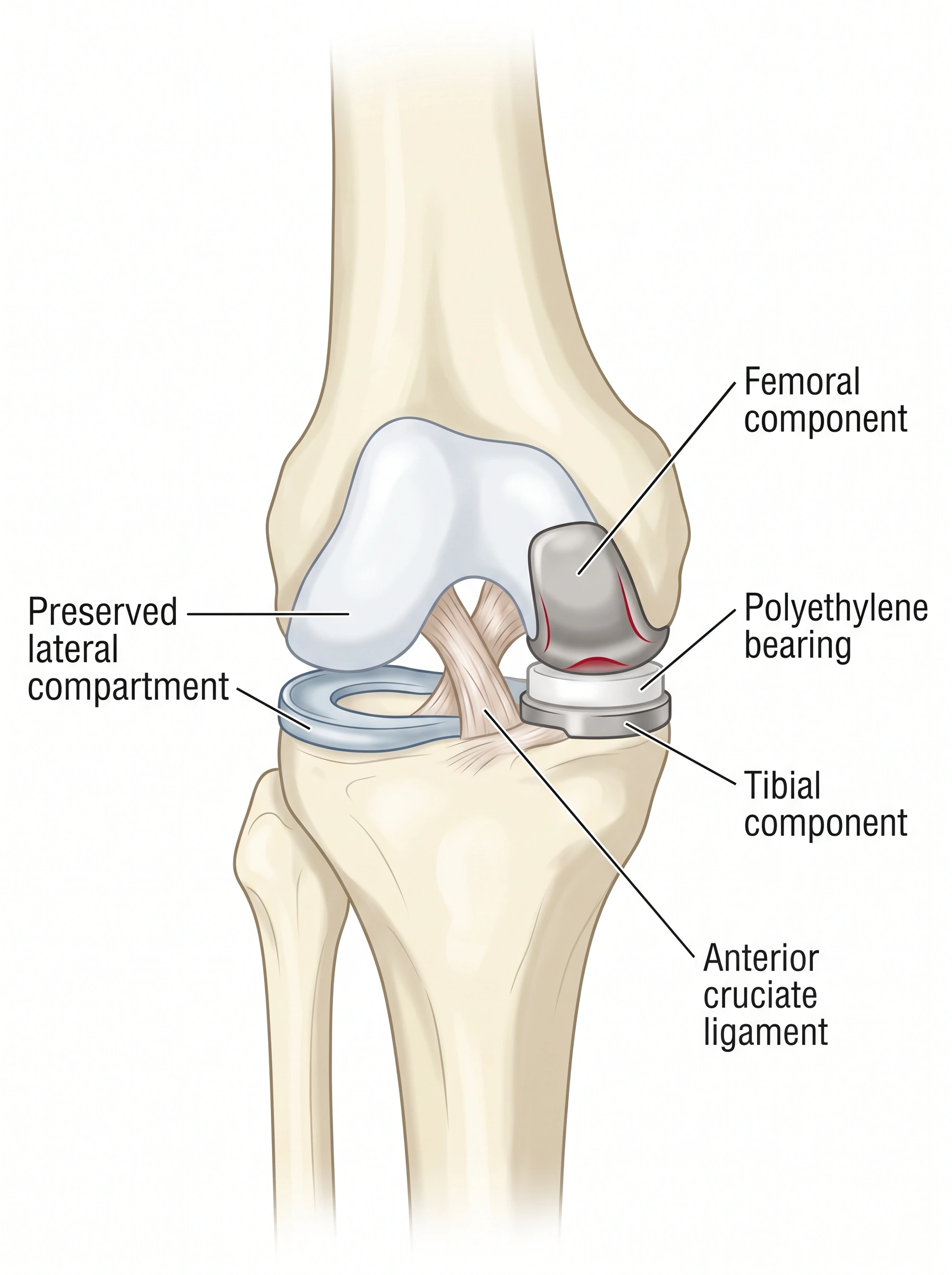
Dr. Ast performs partial knee replacement in Paramus, resurfacing only the damaged part of the knee when arthritis is limited to one compartment. It is considered after non-surgical care. Dr. Ast evaluates whether a partial or total replacement fits each patient's knee and goals.
Michael Ast performs partial knee replacement in Paramus when it is the right step, and reviews every alternative with you first.
What is Partial Knee Replacement?
Partial knee replacement, also called unicompartmental replacement, resurfaces only the worn part of the knee.
The knee has three compartments, and when arthritis affects just one, the healthy parts can be left alone.
It is an option for people whose arthritis is limited to a single compartment and whose ligaments are intact. Because less bone is removed, some people recover more quickly than after a total replacement.
Not everyone with knee arthritis is a candidate. The suitability depends on where the arthritis sits and the overall condition of the knee.
What happens during Partial Knee Replacement, step by step?
Under anesthesia, the surgeon removes the damaged surface of the affected compartment and fits metal and plastic components, leaving the healthy compartments and ligaments in place.
Some surgeons use robotic assistance to plan and position the implant. Dr. Ast confirms candidacy with imaging and, sometimes, findings during surgery.
What is recovery like after Partial Knee Replacement?
Recovery is staged and often somewhat quicker than after a total replacement because less bone is removed.
Many people walk with support soon after surgery, and returning to low-impact activity commonly takes several weeks, according to general guidance from the American Academy of Orthopaedic Surgeons. These are ranges, not promises. Your timeline depends on your health, your rehabilitation, and your daily demands.
Read the full guide to preparing for surgery →
Your own recovery instructions come from the office and are specific to you. This page describes the general course, not a plan to follow.
What do patients ask most?
Am I a candidate for partial knee replacement?+
Is recovery faster than a total knee replacement?+
Can a partial knee replacement be converted to a total one later?+
Will I be able to kneel and squat afterward?+
What are the treatment options?
- 01Activity changes and weight managementActivity changes and weight management.
- 02Physical therapy to strengthen the muscles around the kneePhysical therapy to strengthen the muscles around the knee.
- 03Anti-inflammatory medicine when appropriateAnti-inflammatory medicine when appropriate.
- 04Injections such as corticosteroid or hyaluronic acidInjections such as corticosteroid or hyaluronic acid.
- 05Partial knee replacement, when arthritis is confined to one compartmentPartial knee replacement, when arthritis is confined to one compartment.
- 06Total knee replacement, when arthritis is more widespreadTotal knee replacement, when arthritis is more widespread.
Fellowship trained at Hospital for Special Surgery (Adult Reconstruction and Joint Replacement surgery). Sees patients in Paramus.
About Dr. Ast →