What is Ankle Fusion?
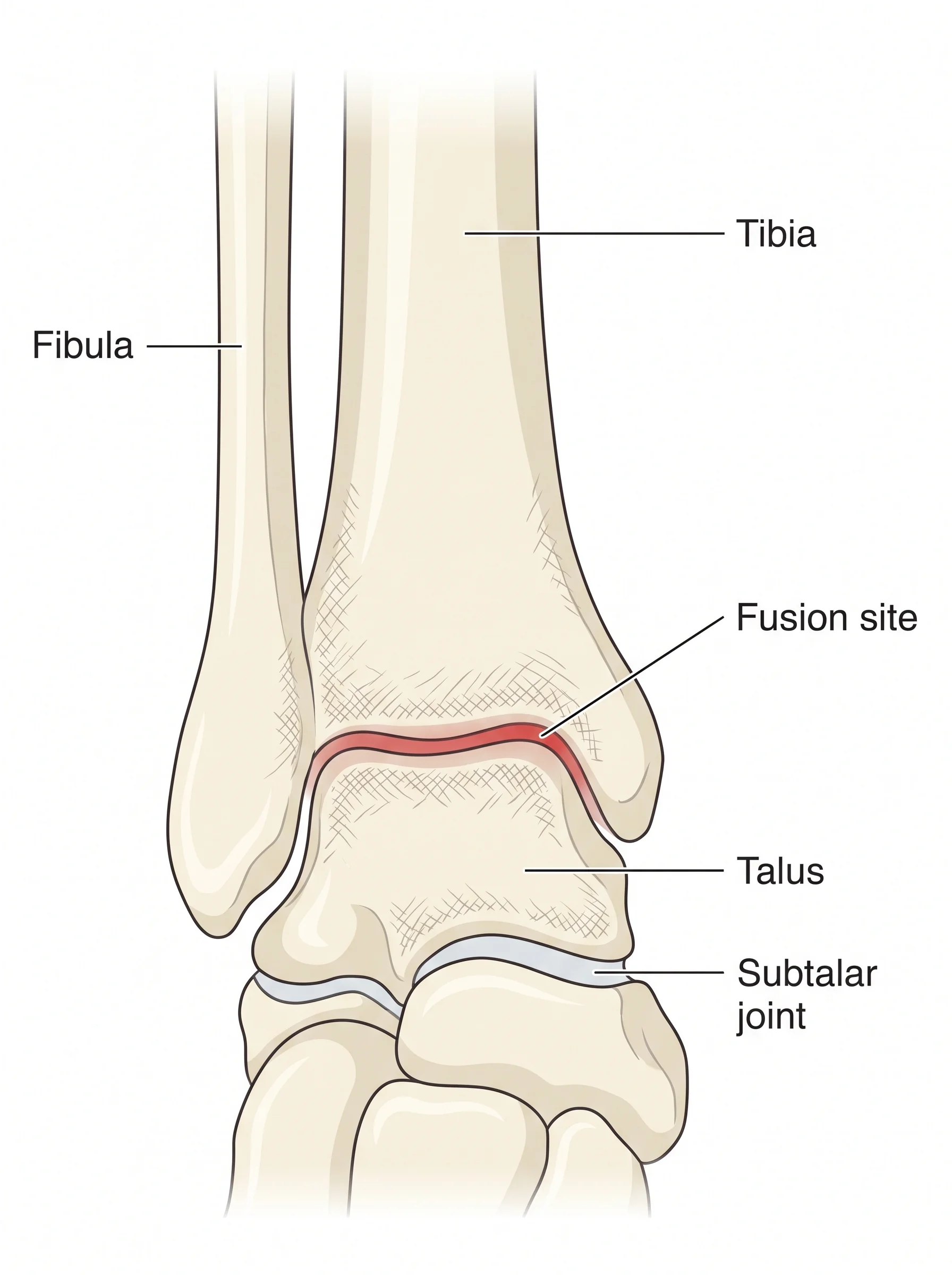
Ankle fusion, whose medical name is ankle arthrodesis, is surgery that joins the bones of the ankle so they grow together into one solid piece.
Arthrodesis means fusing a joint so it no longer moves. Once the bones heal as a unit, the worn surfaces can no longer rub, and the arthritis pain that came from that motion is removed.
Ankle arthritis wears away cartilage, the smooth cushion on the ends of bones. When the cushion is gone, bone grinds on bone with each step, causing pain, stiffness, and swelling. Fusion answers this by taking away the motion at the painful joint.
Losing motion at the ankle sounds drastic, but nearby joints in the foot take on some of the work, and many people walk comfortably after a solid fusion. Fusion is a long-tested option for advanced ankle arthritis and is often chosen for younger or more active people, for ankles with poor alignment or bone quality, and for those in heavy-demand work, where an implant might be less suitable. It is one of two main surgical answers; the other is ankle replacement, which keeps some motion.
Fusion is not a first step. It is considered when arthritis is advanced and non-surgical care has been fully tried.
What are the symptoms of Ankle Fusion, and when should you see a specialist?
People who reach the point of considering fusion usually have long-standing ankle arthritis.
Common experiences include the following.
- Deep ankle pain that worsens with walking and standing. - Stiffness, worse after rest or in the morning. - Swelling after activity. - A grinding or catching feeling. - Difficulty on stairs, slopes, and uneven ground. - Pain that limits work and daily life.
See a foot and ankle specialist when ankle pain steadily limits your activity despite rest, shoe changes, and over-the-counter measures, or when you are avoiding things you value because of the ankle. There is no need to wait until walking is nearly impossible. An earlier visit widens your choices.
How is Ankle Fusion diagnosed, and what does the visit involve?
The specialist asks how the arthritis began, whether there was a past injury or fracture, how far you can walk, and what eases or worsens the pain.
Many arthritic ankles trace back to an old injury.
The exam checks ankle motion, tender spots, the alignment of the leg, and how you walk. The health of the joints next to the ankle is also assessed, because those joints will share more of the load after a fusion.
Weight-bearing X-rays, taken while you stand, show the joint under load and the degree of wear and misalignment. A CT scan, which is a set of detailed cross-section images, is sometimes ordered to look closely at the bone and nearby joints. Together these guide which path fits your ankle: fusion, replacement, or continued non-surgical care.
What happens during Ankle Fusion, step by step?
Before the day. You and the team confirm the plan and the anesthesia.
Anesthesia is the medicine that keeps you comfortable; ankle fusion often uses general or spinal anesthesia with a nerve block for pain control. The choice is made with the anesthesia team.
In the operating room. The ankle is cleaned and positioned. The surgeon makes an incision to reach the joint. Fusion can be done through open incisions or, in some cases, with arthroscopy, which uses a small camera and small cuts.
Preparing the surfaces. The surgeon removes the remaining worn cartilage down to healthy bone on both sides of the joint. Fresh bone surfaces are what allow the bones to grow together. In some cases a bone graft, which is added bone tissue, is used to help healing.
Fixing the position. The surgeon sets the ankle in the position that allows the most comfortable walking, then holds the bones together with screws, and sometimes a plate or rod. Getting the position right is central to a good result.
Closing. The incision is closed and a splint or cast is applied.
After surgery. Ankle fusion may involve a short hospital stay or may be outpatient, depending on your health and the plan. You will not drive yourself home, so arrange a ride in advance.
The operation length varies with the method. The team will give you the specifics for your plan.
What is the recovery timeline for Ankle Fusion?
Recovery is measured by what you can do, and healing varies from person to person.
The ranges below reflect general guidance from the American Academy of Orthopaedic Surgeons (AAOS). These are ranges, not promises. Fusion asks for patience, because the bones must knit solidly before full weight.
Milestone 1: protecting the fusion (early weeks). The ankle is held still in a splint or cast, and weight is kept off the foot as directed. The leg is elevated much of the day to control swelling. You pass this stage when the incision is healing and swelling settles.
Milestone 2: bone knitting. The surgeon watches X-rays for signs that the bones are fusing before allowing more weight. A solid fusion generally takes on the order of three months to form, and sometimes longer, according to general guidance from the AAOS. These are ranges, not promises. You reach this milestone when imaging shows healing and the surgeon clears more weight.
Milestone 3: weight-bearing and walking. With clearance, weight increases through a boot and then a supportive shoe, often with physical therapy for strength and balance. You reach this stage when you can walk for daily tasks with steady comfort.
Milestone 4: return to fuller activity. Activity returns gradually as strength builds. Full recovery, including confident walking and the last of the swelling, can take up to a year, according to general guidance from the AAOS. These are ranges, not promises.
Because the ankle no longer bends up and down at the fused joint, your walking pattern changes and shoes with a slightly rounded sole can make walking smoother. Many people adapt well.
Read the full guide to preparing for surgery →
Your own recovery instructions come from the office and are specific to you. This page describes the general course, not a plan to follow.
How should you prepare for surgery?
A little preparation makes the visit more useful.
- Set up a rest area. Arrange a spot to sit with the ankle raised above heart level, with water, medicine, and a phone charger nearby. - Make paths safe. Remove rugs and cords, and plan how you will move between rooms while keeping weight off the foot. - Assistive devices. A knee scooter, crutches, or a walker helps during the no-weight phase. Practice before surgery if you can. - Transportation. Arrange a ride home and rides to follow-up visits. You will not drive while the ankle is protected and while you take pain medicine. - Time off work. The length depends on your job and time on your feet. Fusion often needs a longer protected period than some other foot surgeries. Ask the office for guidance. - Help at home. Have someone available for the first days for meals, errands, and getting around, and prepare easy meals ahead. - Bathing. Ask how to keep the splint or cast dry; a shower seat and waterproof cover help.
Which warning signs should you call about?
Expect some swelling and soreness.
Call the surgeon's office if you notice the following.
- Fever, or growing redness, warmth, or drainage from the incision, which can signal infection. - Pain that keeps worsening or is not controlled by your prescribed plan. - A splint or cast that feels too tight, or new numbness in the toes. - Toes that turn pale, blue, or cold.
Seek emergency care right away for calf pain or swelling, sudden chest pain, or trouble breathing, which can point to a blood clot. When unsure, call the office. Early questions are welcome.
What results can you expect from Ankle Fusion?
Ankle fusion has a long track record of relieving arthritis pain by removing the painful motion, and satisfaction is generally high for the right person, according to general guidance from the American Academy of Orthopaedic Surgeons (AAOS).
These are ranges, not promises.
Honest points to keep in mind:
- The fused ankle no longer bends up and down at that joint, which changes walking; many people adapt well. - In some cases the bones are slow to fuse or do not fully fuse, which may need further treatment, according to general guidance from the AAOS. These are ranges, not promises. - Over years, the extra work asked of nearby joints can lead to arthritis in those joints for some people, according to general guidance from the AAOS. These are ranges, not promises.
The surgeon will give you a realistic picture for your ankle and explain how fusion compares with replacement.
What are the treatment options?
- 01Activity adjustmentSwapping high-impact activity for lower-impact options reduces stress on the joint.
- 02BracingAn ankle brace or boot supports the joint and limits painful motion.
- 03Shoe changes and orthoticsA rocker-bottom or stiff sole reduces ankle motion and pain, and inserts help spread load.
- 04Weight managementLowering body weight reduces force through the ankle.
- 05Anti-inflammatory measuresIce and, when appropriate, anti-inflammatory medicine can calm flares. Ask the office first if you have other conditions.
- 06InjectionsIn some cases a joint injection can ease pain for a time.
- 07Physical therapyGuided exercise improves strength and balance around the ankle.
- 08Deciding between fusion and replacement?The office can explain the trade-offs for your ankle at your pace. Insurance questions are answered by the office.
What do patients ask most?
Will I walk normally after an ankle fusion?+
How is fusion different from ankle replacement?+
How long until the ankle is healed?+
Can a fusion be changed to a replacement later?+
Does insurance cover ankle fusion?+
Education and training
Medical school at Temple University School of Medicine. Residency at North Shore - LIJ Health System. Fellowship at Hospital for Special Surgery.
- FellowshipHospital for Special SurgeryAdult Reconstruction and Joint Replacement surgery
- ResidencyNorth Shore - LIJ Health SystemOrthopedic Surgery
- Medical schoolTemple University School of MedicineDoctor of Medicine
- Board statusAmerican Board of Orthopaedic SurgeryBoard certified
HSS Paramus - Midland Ave
15 E. Midland Ave.
Suite 1A, Paramus, NJ 07652
Phone(201) 599-8056